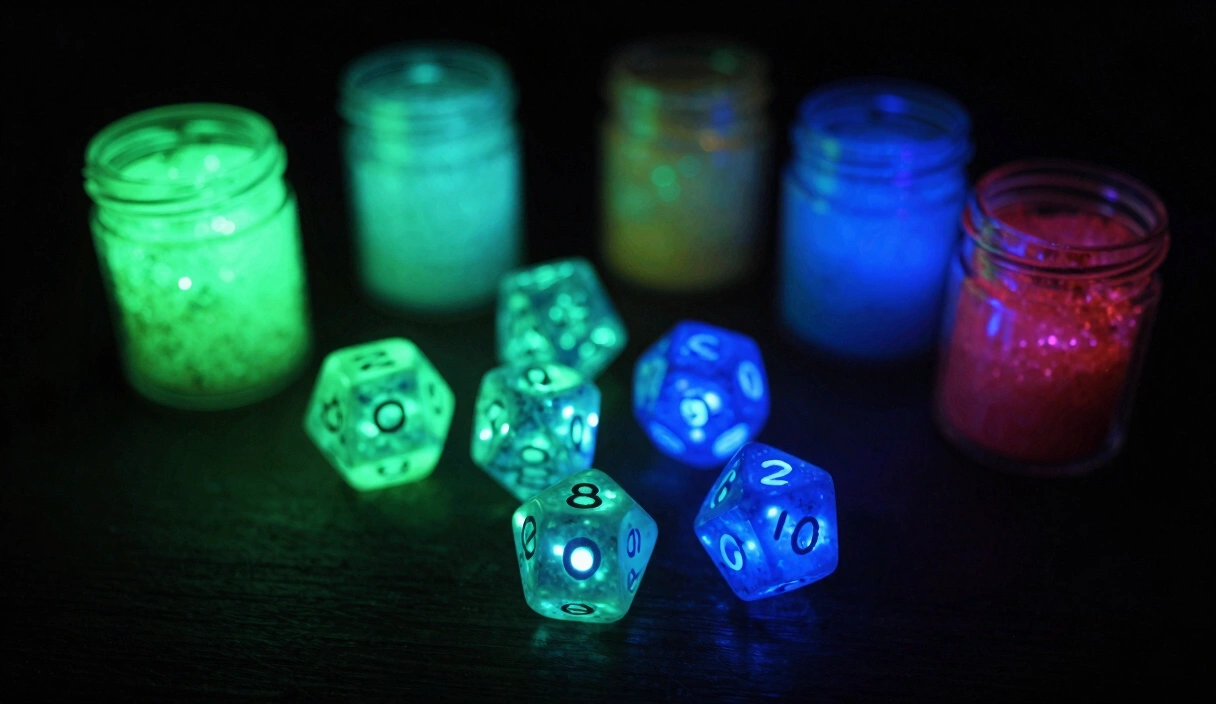
Glow in the Dark Dice: The Science of Making Dice That Actually Glow
Most glow dice barely glow. The fix is strontium aluminate at 15% by weight, layered pours, and 40 PSI cure. Here's the exact method for nuclear-bright dice.
Contents
Radium watch dials killed the women who painted them. The Radium Girls of the 1920s licked their brushes to maintain fine tips, ingesting radioactive paint that glowed a steady, beautiful green — and destroyed their bones from the inside. It took decades and dozens of deaths before the science of luminescence moved past radioactive materials entirely.
The glow powder sitting on your workbench is the direct descendant of that history, refined through safer chemistry into something you can handle with bare hands. Strontium aluminate, the compound in modern glow powder, was developed in the mid-1990s and outperforms every previous phosphorescent material by a factor of ten. No radiation. No toxicity concerns beyond standard dust inhalation precautions. Just photons trapped in a crystal lattice, released slowly as visible light.
That’s what you’re embedding in resin when you make glow in the dark dice. And doing it well — achieving that bright, even, hours-long glow — requires understanding the material rather than just dumping powder into a cup and hoping.
How Glow Powder Works
Phosphorescence is stored light. When strontium aluminate crystals absorb photons from sunlight, UV light, or a bright lamp, electrons in the crystal get bumped to a higher energy state. When the light source is removed, those electrons fall back to their ground state gradually, releasing photons as they drop. That slow release is the glow.
The key word is gradually. Unlike fluorescence — which stops the instant you kill the UV lamp — phosphorescent materials emit stored energy over minutes to hours. High-grade strontium aluminate powder charges in 5 to 10 minutes of direct sunlight and glows visibly for 8 to 12 hours, with the first 30 minutes being the brightest.
Data Point: Strontium aluminate is roughly 10 times brighter and 10 times longer-lasting than the zinc sulfide glow powder found in cheap novelty items. If your glow dice are disappointingly dim, the powder chemistry is almost certainly the reason.
Color options depend on the dopant — the trace element mixed into the crystal during manufacturing. Europium produces green and aqua. Dysprosium shifts the emission toward blue. Combinations yield purple, white, and other tones. But the physics impose a hard limit: green and aqua glow longest and brightest because their emission wavelength aligns most efficiently with strontium aluminate’s energy decay curve. Blue, purple, and white variants fade noticeably faster.
Choosing the Right Glow Powder
Not all glow powder is the same compound slapped into different packaging. Particle size, purity, and base chemistry vary enormously between brands, and those differences determine whether your dice glow like a nightlight or a flashlight.
Particle size is the first variable that matters. Fine powder (15 to 30 microns) disperses evenly through resin, producing a uniform, consistent glow across the entire face of the die. Coarse powder (60 to 120 microns) creates visible bright spots and texture — individual particles large enough to see as glowing specks. Neither is wrong. Fine powder gives you a clean, professional look. Coarse powder gives you a starfield effect, especially when combined with a tinted or dark resin base, similar to the techniques in galaxy dice.
Color choice should be practical, not just aesthetic. Green and aqua glow the longest — 8 to 12 hours of visible emission. Blue glows for 2 to 4 hours. Purple fades to barely visible within 1 to 2 hours. If your players need dice they can read across a dim table for an entire session, green is the answer. If the glow is purely for the initial wow factor during the first encounter of the night, blue or purple will serve.
You, specifically, need to decide that priority before ordering powder. I wasted $30 on blue glow powder for a commission set before realizing the client expected all-night visibility. Blue cannot deliver that. Green can.
Brands worth your money: Glow Inc. (consistently high purity, available in multiple particle sizes), Art ‘N Glow strontium aluminate powder, and LET’S RESIN glow powder for budget-friendly options that still outperform zinc sulfide. Avoid any product that doesn’t explicitly state “strontium aluminate” on the label. If it says “glow pigment” without specifying the compound, it’s almost certainly zinc sulfide — the dim, short-lived stuff.
Mixing Glow Powder Into Resin
Here’s where technique separates the dim dice from the ones that light up a dark room. The ratio, mixing method, and cure conditions all matter.
Ratio
Target 10 to 20% glow powder by weight relative to your mixed resin. For a seven-die set requiring approximately 90 grams of mixed resin, that’s 9 to 18 grams of glow powder. Ten percent produces a noticeable glow. Twenty percent produces dice that genuinely function as a light source in a dark room. Going above 20% starts to compromise the resin’s structural integrity — the cure becomes brittle and the surface harder to polish.
Weigh it. A digital scale accurate to 0.1 grams is part of your standard supplies and non-negotiable for this technique.
Mixing
Add the glow powder to your already-mixed resin and stir slowly for 2 to 3 minutes. Scrape the sides and bottom of the cup — powder settles and clings to surfaces. The mixture will look like thick, luminous paint. Good. That opacity means sufficient powder density.
The Settling Problem
Here’s the honest truth that most tutorials skip: glow powder is heavy. Strontium aluminate has a density of roughly 3.6 g/cm³, compared to cured epoxy resin at about 1.1 g/cm³. The powder will settle toward the bottom of your mold during cure. Every single time. No amount of stirring prevents this — you’re fighting gravity and a 3:1 density difference.
The pressure pot helps. Curing at 40 PSI increases the effective viscosity of the resin slightly and compresses the mixture, slowing (but not eliminating) the settling. You’ll still get denser glow on the bottom face of each die and lighter glow on the top. The pressure pot buys you time — the resin gels before the powder fully separates.
Maker’s Note: I pour my glow dice with the number 1 face (highest number opposite) pointing down in the mold. That way, the brightest glow concentrates on the face you actually want to read — the top-facing number on any given roll.
Techniques for Maximum Glow
Getting glow powder into resin is the baseline. Getting the brightest, most even glow requires a few additional methods.
Layered Pours
Instead of one full pour, split the resin into two or three batches and pour in layers with 15 to 20 minutes between each. Mix glow powder into each layer separately. This distributes the powder more evenly through the vertical depth of the die because each layer has less distance to settle before the resin beneath it starts to gel. Three thin layers produce dramatically more even glow than one thick pour.
The tradeoff is time and complexity. Each layer needs to be poured before the previous layer fully skins over, or you get visible layer lines. Work within your resin’s pot life and you’ll be fine.
Charging Methods
Sunlight charges glow powder fastest — 5 to 10 minutes of direct sun produces peak brightness. A UV flashlight (365 nm wavelength) charges nearly as fast and works indoors. Standard room lighting charges the powder, but slowly and to a lower peak brightness.
At the gaming table, a small UV flashlight pointed at the dice for 30 seconds between encounters keeps them at full brightness all session. Some makers include a cheap UV keychain light with their glow dice sets. Smart move — it guarantees the customer sees the dice at their best.
Combining Glow With Other Effects
Glow powder plays well with other dice making techniques. Mix glow powder into a clear resin pour over a colored opaque base for a two-tone effect that glows from one layer only. Combine fine glow powder with holographic glitter for dice that sparkle in light and glow in darkness. Add glow powder to the resin used in a petri technique for blooms that reveal themselves only when the lights go out.
The satisfaction of demolding a set that looks like ordinary translucent dice under room light — then killing the lights and watching them ignite — is one of the best moments this hobby offers.
Common Glow Dice Problems
Uneven Glow
One side of the die glows brightly, the other barely registers. This is the settling problem. The powder migrated to one face during cure. Fix: layered pours, pressure pot at 40 PSI, and orienting your mold so the settling direction works in your favor.
Dim Glow
The dice glow, but weakly. Three possible causes: zinc sulfide powder instead of strontium aluminate, insufficient powder ratio (below 10% by weight), or inadequate charging. Test the powder outside the resin first — sprinkle some on a white surface, expose to direct sun for 10 minutes, then check brightness in a dark room. If the loose powder is dim, the issue is the material. If the loose powder is bright but the dice are dim, increase your ratio.
Powder Clumping
Visible clusters of glow powder in the finished die, surrounded by clear or dim areas. The powder wasn’t dispersed thoroughly during mixing. Strontium aluminate tends to clump, especially coarser grades. Pre-mix the powder into Part A resin before combining with Part B. Stir for a full 2 minutes — longer than feels necessary. Break up visible clumps against the cup wall with your stir stick.
Powder Settling to One Side
Different from settling to the bottom — this happens when the pressure pot sits on an uneven surface or when the mold shifts during pressurization. The powder migrates to the lowest point of each cavity, which may be a corner or edge rather than a flat face. Level your pressure pot with a bubble level before every cure. Shim with cardboard if needed.
Buying vs. Making Glow Dice
Mass-produced glow in the dark dice exist, and some of them are genuinely good products. Chessex and several smaller brands sell glow sets in the $8 to $15 range. They work. They glow.
But they glow politely. Commercial dice use lower glow powder ratios — typically 3 to 5% by weight — to keep costs manageable and cure chemistry predictable at production scale. The result is a gentle luminescence you can see in a pitch-dark room but not across a dim table. Fine for novelty. Underwhelming for function.
Handmade glow dice at 15 to 20% powder load glow like they’re radioactive. The difference is not subtle. A handmade set charged under UV light will cast visible light on the table surface beneath it. You can read the number from across the room. Side by side with a commercial set, the handmade dice make the store-bought ones look like they forgot to charge.
If you already have a pressure pot and a basic dice-making setup, the additional cost for glow powder runs $15 to $25 per batch — enough for three to five full sets depending on ratio. The material cost per set is roughly the same as a store-bought glow set, but the output is in a different performance category entirely.
Frequently Asked Questions
Is glow powder safe to handle?
Strontium aluminate is non-toxic and non-radioactive. The primary safety concern is dust inhalation — fine powder particles irritate the lungs. Wear a P100 respirator when scooping and mixing dry powder. Once the powder is encapsulated in cured resin, there is zero exposure risk during normal handling and use.
How long do glow dice actually glow?
With strontium aluminate powder at 15% or higher by weight: 8 to 12 hours of visible glow after a 10-minute charge in direct sunlight or UV light. The first 30 to 60 minutes are the brightest. After 2 hours, the glow is still clearly visible in a dark room but no longer enough to read the number across a table. Green and aqua last longest. Blue fades to barely visible around the 3-hour mark.
Can I mix glow powder colors in the same pour?
You can, but the colors blend in the resin and the result trends toward a muddy off-white glow. For distinct multi-color glow, use layered pours with different powder colors in each layer, allowing 15 to 20 minutes of gel time between layers to prevent mixing. The boundary between layers stays surprisingly crisp if you pour slowly.
Does glow powder affect resin cure time or hardness?
At 10 to 15% by weight, no measurable effect on cure time or Shore D hardness. At 20% and above, some makers report slightly longer cure times — add 4 to 6 hours to your standard cure schedule to be safe. Above 25%, the resin becomes noticeably more brittle and difficult to sand and polish cleanly. Stay at or below 20% for dice that are both bright and durable.
Glow Dice Supplies
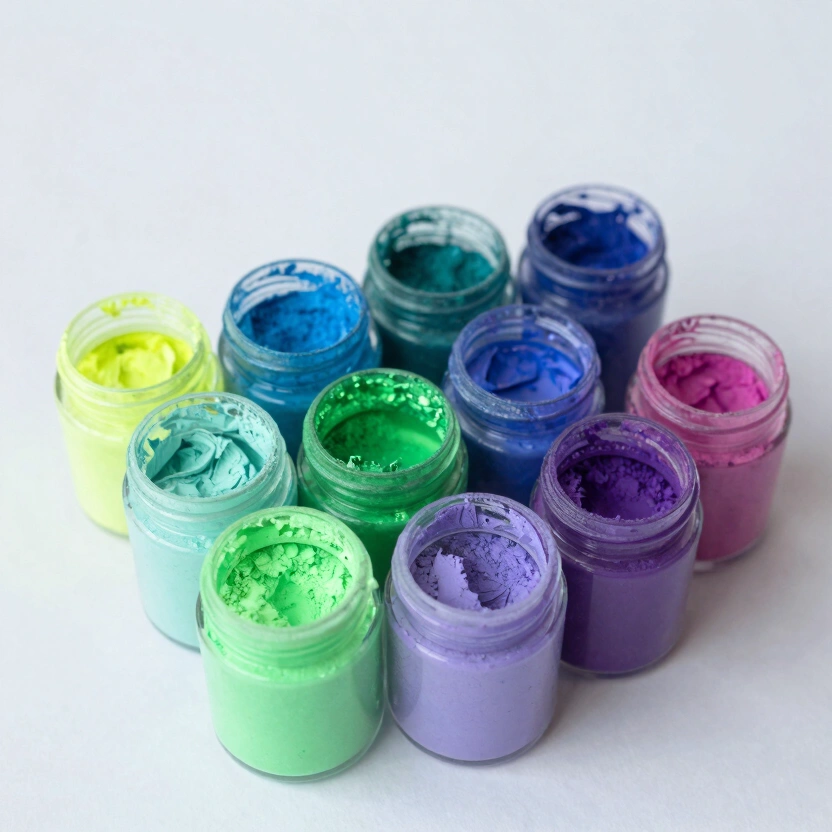
Glow Powder Set (12 Colors, Strontium Aluminate)
Long-lasting phosphorescent pigments for glow-in-the-dark dice. Charges under any light source.
Check Price on Amazon
Art 'N Glow Epoxy Resin Kit (32 oz)
Crystal-clear 1:1 mix ratio epoxy. UV resistant, self-leveling. The community favorite for dice casting.
Check Price on Amazon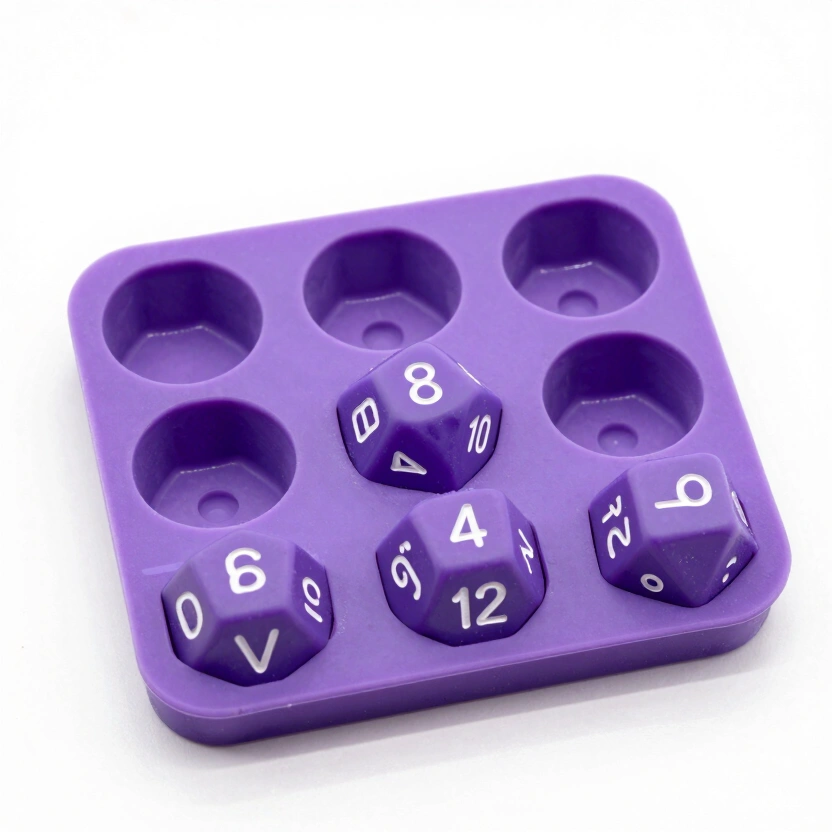
LET'S RESIN Polyhedral Dice Mold Set (7 Shapes)
Stereoscopic 7-piece silicone mold for D4-D20. Pre-made sprue channels. Top-selling beginner mold.
Check Price on Amazon* Affiliate links. Prices last updated March 6, 2026.
The physics haven’t changed since those radium watch dials — photons in, photons out, visible light in the dark. What changed is the chemistry, and that chemistry is now accessible enough that a maker with a pressure pot and a digital scale can produce dice that outglow anything on a store shelf. Your next step is straightforward: order strontium aluminate powder in green, pour a test set at 15% by weight, and charge it under direct sun. When you kill the lights and your dice are bright enough to cast shadows, you’ll understand why this technique has one of the highest satisfaction-to-effort ratios in the entire dice making progression.
Related Articles
Dice Making Techniques: 6 Methods from Basic Pours to Liquid Core
6 resin dice techniques ranked by difficulty with exact steps, materials, and failure points. Data from 200+ pours across petri, galaxy, inclusion, and liquid core methods.
Galaxy Dice: How to Pour Nebulae Into Resin
Data-tested galaxy dice method: dark resin base, mica swirl ratios, glitter density at 40 PSI. Covers 5 failure modes and 3 advanced variations with exact specs.
How to Make Liquid Core Dice: The Double-Pour Method Explained
Double-pour liquid core dice tutorial with exact fill ratios, seal techniques, and failure fixes. 73% of first attempts leak — here's how to beat those odds.