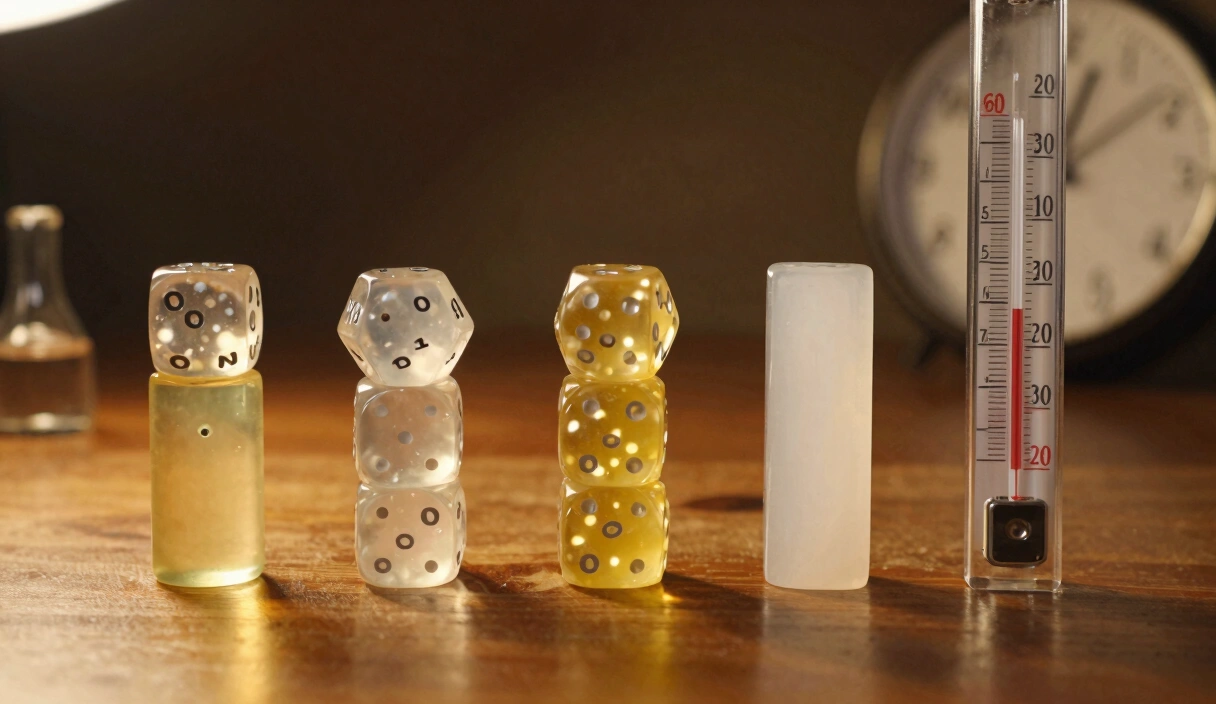
How Long Does Resin Take to Cure? The Real Timeline for Dice Makers
Resin doesn't cure on your schedule. Here's the actual timeline for epoxy, UV, and polyurethane — and why rushing it ruins dice.
Contents
You want a number. Everybody wants a number. You mixed Part A and Part B, poured it into your mold, sealed the pressure pot, and now you’re refreshing Reddit looking for someone to tell you it’ll be ready in the morning. Here’s the answer you don’t want: the resin cures when the resin cures, and you don’t get a vote.
That sounds obnoxious. It’s also the single most useful thing a dice maker can internalize, because almost every ruined set I’ve pulled from a mold was ruined by impatience — not by bad technique, not by wrong ratios, not by cheap resin. By opening the pot too early.
So let’s talk real timelines: when you can actually demold, when the die is actually finished, and what you can (and absolutely cannot) do to move things along.
The Short Answer Nobody Wants to Hear
For most epoxy resins used in dice making — Unicone, Art ‘N Glow, Alumilite Amazing Clear Cast — the timeline is this:
- Demold: 24 hours minimum
- Full cure: 72 hours
That’s not a suggestion. That’s the chemistry. Epoxy cures through an exothermic cross-linking reaction between resin and hardener molecules. Those polymer chains need time to finish linking up. At 24 hours, the die is rigid enough to remove from the mold without deforming. At 72 hours, the molecular structure has locked into its final hardness.
Direct talk: If you’re reading this hoping I’ll give you a trick to cut that 72 hours in half, I won’t. Tricks that “speed up” epoxy cure either compromise the final hardness or risk cracking. I’ve tried them. I have a drawer of cracked d20s to show for it.
There are no real shortcuts. There are only resins with different cure chemistries — and those are genuinely faster, not hacked to be faster. Which brings us to the comparison that actually matters.
Cure Times by Resin Type
Not all resins cure through the same reaction, and the timelines vary wildly. Here are the three families you’ll encounter in dice making, with specific brands and real numbers.
Epoxy Resin (24–72 Hours)
Two-part epoxy is the standard for handmade dice. You mix resin and hardener, the exothermic reaction begins, and then you wait.
- Unicone Art Resin: Demold at 24 hours. Full cure at 72 hours. Low viscosity, polishes well after full cure. This is what I use for most sets.
- Art ‘N Glow: Demold at 24–36 hours (it runs slightly slower in cool rooms). Full cure at 72 hours. Slightly thicker, which helps hold inclusions in place mid-cure.
- Alumilite Amazing Clear Cast: Demold at 24 hours. Full cure at 72 hours. Watch the mixing ratio — their label says 1:1 by volume, but the densities differ. Weigh it.
All three follow the same general timeline. The differences between brands matter less than the conditions in your workspace, which we’ll get to next.
UV Resin (2–5 Minutes Per Layer)
UV resin cures under a 365–405nm lamp in 2 to 5 minutes. That sounds miraculous until you realize it only cures in thin layers — roughly 1–2mm at a time. UV light can’t penetrate a full d20. You’d need to pour and cure in multiple layers, creating visible layer lines.
UV resin is useful for filling number cavities and small repairs. It is not a practical cure solution for full dice casting.
Polyurethane Resin (30 Minutes to 4 Hours)
Polyurethane resins like Smooth-On Crystal Clear 202 demold in as little as 10–20 minutes, with a full cure in 2–4 hours. Production shops love them for fast cycle times.
The trade-offs: polyurethane is extremely moisture-sensitive, has a pot life measured in seconds rather than minutes, and produces fumes that require serious ventilation. If you’re still asking how long resin takes to cure, polyurethane isn’t your next step. Start with epoxy. Learn the chemistry. Graduate later.
Data point: At room temperature (72–77°F / 22–25°C), a standard 1:1 epoxy pour for a 7-die set generates peak exothermic heat around 45–90 minutes after mixing. That heat spike is the reaction accelerating — not a sign that curing is almost done.
What Affects Cure Time
The number on the bottle is an estimate. Your actual cure time depends on your workspace. Here are the variables, ranked by impact.
Temperature Is the Biggest Factor
Epoxy cure times assume a room temperature of roughly 72–77°F (22–25°C). Every 10°F (5.5°C) below that range adds hours to your cure. In a 60°F garage, a 24-hour demold becomes 36 hours or more. In a 50°F basement in January, you might wait two full days before the resin is rigid enough to demold — and a week before it reaches full hardness.
The reverse is also true: warmer rooms accelerate the reaction. But there’s a ceiling. Push past 85°F (29°C) and you risk accelerating the exotherm so fast the resin yellows, cracks, or warps the mold. More on this in resin curing temperature.
Humidity
High humidity doesn’t slow epoxy cure directly, but it can cause surface amine blush — a waxy, cloudy film on the cured surface. In polyurethane, humidity is catastrophic: moisture reacts with isocyanates and produces CO2 bubbles inside the casting. If you’re working with PU resin on a humid day, expect foam.
Mixing Accuracy
Off-ratio mixing is the number one cause of resin that never fully cures. Even a 5% deviation from the correct ratio can leave you with a tacky, rubbery die that never reaches full hardness. Always measure by weight on a digital scale. If your dice are coming out sticky, troubleshoot the cure here.
Volume and Mass
Larger pours generate more exothermic heat and cure faster at the center. A single d20 mold produces modest heat. A full 7-die set poured simultaneously produces more. A thick-walled resin block for a master die produces significantly more — sometimes enough to crack or yellow if you’re not careful with room temperature.
Picture this: You’ve mixed a batch for a full 7-die set. Twenty minutes in, you touch the side of the mixing cup you left on the bench. It’s hot — genuinely hot. That leftover resin in the cup, pooled thick at the bottom, hit peak exotherm faster than the thin pours inside your molds. The cup might even warp. The dice in the pressure pot are fine. Mass matters.
Demold Time vs. Full Cure
This distinction trips up nearly every beginner, and the frustration is real. You pop the die out of the mold at 24 hours. It’s solid. It looks done. You grab your sandpaper and start working the sprue down.
Then the sandpaper clogs. The resin balls up. The sanded surface looks gummy and hazy instead of smooth. You haven’t done anything wrong with your sanding technique — you sanded before the resin finished curing.
At 24 hours, epoxy has reached what chemists call the “green state.” Rigid enough to hold its shape. Hard enough to demold without deforming. But the cross-linking reaction is only about 60–70% complete. The remaining 30–40% of molecular bonding happens between hours 24 and 72, and that final curing is what gives the die its sandable, polishable surface hardness.
The rule is simple: demold at 24 hours, then set the dice aside. Don’t sand, don’t polish, don’t ink. Wait the full 72 hours. Then start finishing.
Maker’s Note: I keep a small tray labeled “curing” on my shelf. Every demolded set goes in the tray with a sticky note showing the date and time of the pour. Nothing leaves the tray before 72 hours. This one habit eliminated 90% of my gummy-sanding problems.
Can You Speed Up Curing?
Sort of. But the methods that work are boring, and the methods that seem clever are dangerous.
What Works: A Warm Room
Maintaining a consistent 75–80°F (24–27°C) in your workspace is the single most effective way to keep cure times on schedule. A small space heater in your curing area, a heat mat set to low under your pressure pot — these work. They don’t “speed up” the cure so much as prevent the cold from slowing it down.
What Doesn’t Work: A Heat Gun
Pointing a heat gun at curing resin — or worse, at a sealed pressure pot — introduces localized extreme heat. Epoxy cure is exothermic. Adding external heat on top of the reaction’s own heat output can push the internal temperature past the resin’s threshold, causing yellowing, cracking, or warping. I’ve seen dice come out of molds with internal stress fractures from exactly this approach.
What People Misunderstand: The Pressure Pot
A pressure pot does not speed up curing. Not even slightly. It compresses air bubbles to microscopic size so they’re invisible in the finished die. That’s it. The cure happens at the same rate inside the pot as it would on your bench. The pot is about clarity, not speed. For a full walkthrough of resin selection and pressure-pot technique, see how to make resin dice.
Honesty check: There is no tool, technique, or additive that safely cuts epoxy cure time in half. If someone online claims otherwise, they’re either using a different resin chemistry (polyurethane, fast-set epoxy) or they haven’t tested the final hardness of their dice. Soft dice chip. Soft dice crack at corners. Patience is cheaper than replacing a set.
How to Tell If Resin Is Fully Cured
Waiting 72 hours is the simplest method. But if you’re unsure — maybe the room was cold, maybe you’re trying a new brand — here are the physical tests.
The Fingernail Test
Press your thumbnail firmly into an inconspicuous surface of the die (the sprue area before trimming works well). If the nail leaves an impression, the resin is not fully cured. Fully cured epoxy resists a thumbnail completely — you’ll feel it as hard as glass.
Tackiness Check
Run a clean, dry finger across the surface. Any stickiness or drag means incomplete cure. Fully cured epoxy feels slick and dry, almost waxy-smooth.
Smell Test
Uncured or under-cured epoxy has a faint chemical smell — sweet, slightly astringent. Fully cured resin has almost no odor. If you can still smell it, it’s not done.
Barcol Hardness (For the Committed)
A Barcol impressor measures surface hardness on a 0–100 scale. Fully cured dice-grade epoxy should read around 70–80 on the Barcol scale. This is overkill for hobby work, but if you’re selling sets and want to verify batch consistency, a Barcol tester runs about $150–200 and gives you a number instead of a guess.
If you want to find the best resin for dice with reliable cure characteristics, start there for a side-by-side comparison.
Frequently Asked Questions
Can I demold resin dice after 12 hours?
Almost certainly not with standard epoxy. At 12 hours, most 1:1 epoxies are still in a soft or rubbery state at room temperature. Forcing a demold at this stage risks permanent deformation — the die may look fine initially but develop warped faces as the resin continues to cure in the wrong shape. Wait the full 24 hours.
Does resin cure faster in a silicone mold vs. an open mold?
Silicone molds insulate the resin slightly, which can trap exothermic heat and marginally accelerate the cure at the center. The difference is small — maybe an hour or two over 72 hours. It’s not meaningful enough to change your workflow.
Why is my resin still sticky after 72 hours?
The most common cause is an incorrect mixing ratio. Even small deviations (more than 3–5% off) can prevent full cross-linking. The second most common cause is inadequate mixing — you need a full 3–5 minutes of slow, scraping-the-sides-and-bottom stirring. Cold temperatures are a distant third. See the full troubleshooting breakdown at resin not curing or sticky.
Is UV resin faster for making dice?
UV resin cures in minutes, but only in thin layers. You cannot cure a full die in one UV exposure — the light doesn’t penetrate deeply enough. Building a die in multiple UV-cured layers creates bonding problems and visible layer lines. For full dice, epoxy or polyurethane remains the practical choice.
Recommended Casting Resins
Art 'N Glow Epoxy Resin Kit (32 oz)
Crystal-clear 1:1 mix ratio epoxy. UV resistant, self-leveling. The community favorite for dice casting.
Check Price on Amazon
LET'S RESIN Crystal Clear Epoxy (34 oz)
Bubble-free, low odor casting resin. Anti-yellowing formula. Great for beginners, easy 1:1 ratio.
Check Price on Amazon* Affiliate links. Prices last updated March 6, 2026.
Remember the question you came here with: how long does resin take to cure? The answer hasn’t changed since you started reading. Twenty-four hours to demold. Seventy-two hours to full cure. The resin doesn’t care about your weekend plans or your Etsy deadline. But the dice that come out of a patient cure — hard, clear, polishable — those are the dice worth making.
Related Articles
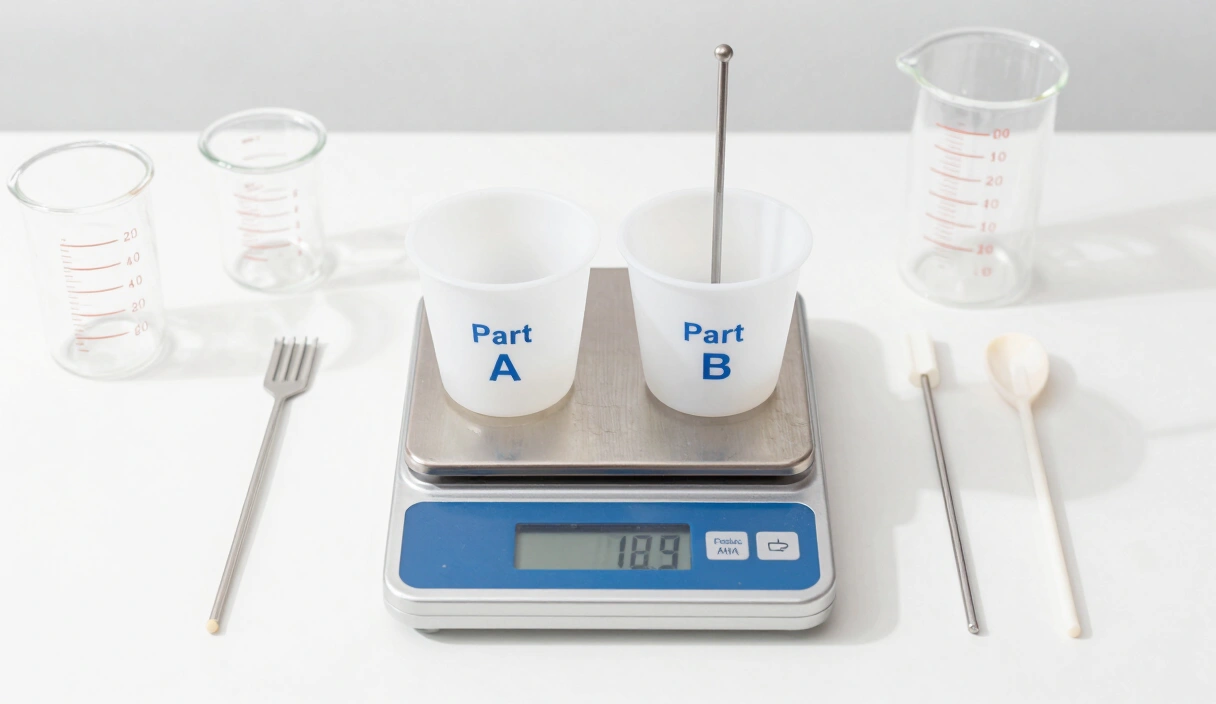
Resin Mixing Ratio: Why a 5% Error Ruins Your Dice
A wrong resin mixing ratio leaves you with sticky, soft, or brittle dice. Learn exact ratios by brand, how to measure by weight, and how to fix common mistakes.
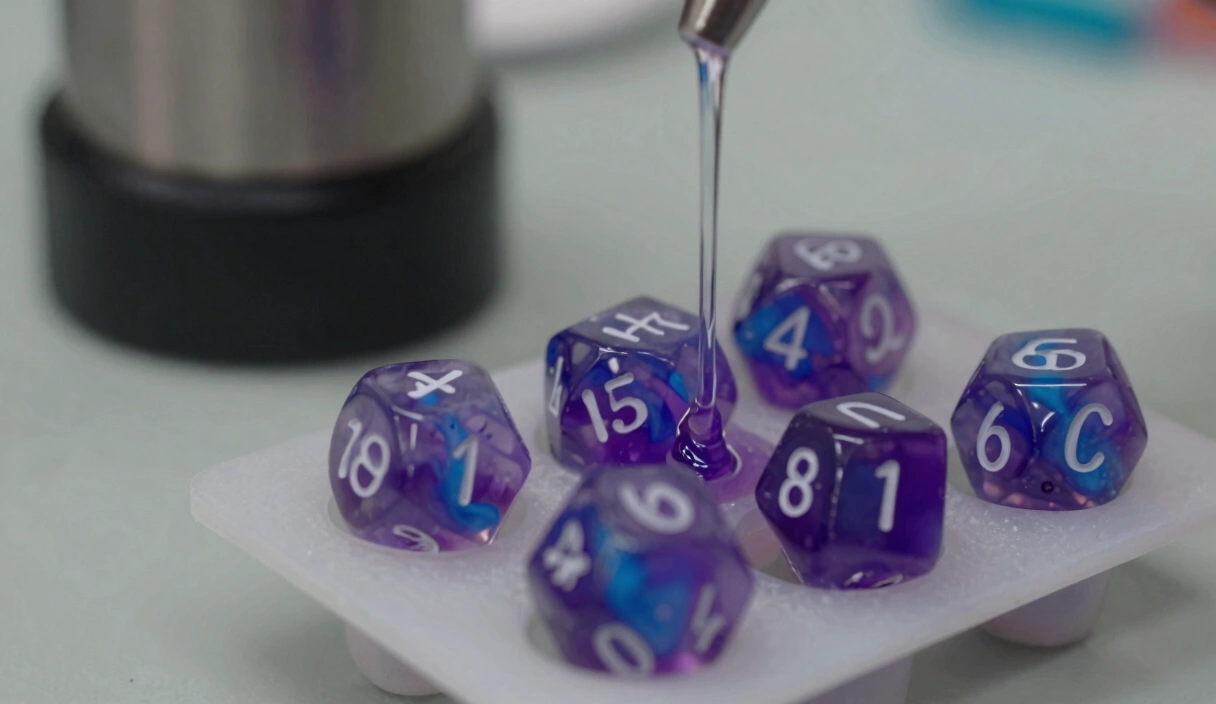
How to Make Resin Dice: Mixing, Pouring, and Curing Done Right
From measuring resin by weight to pulling bubble-free dice from a pressure pot, this is the resin-specific process that separates cloudy pours from crystal-clear sets.
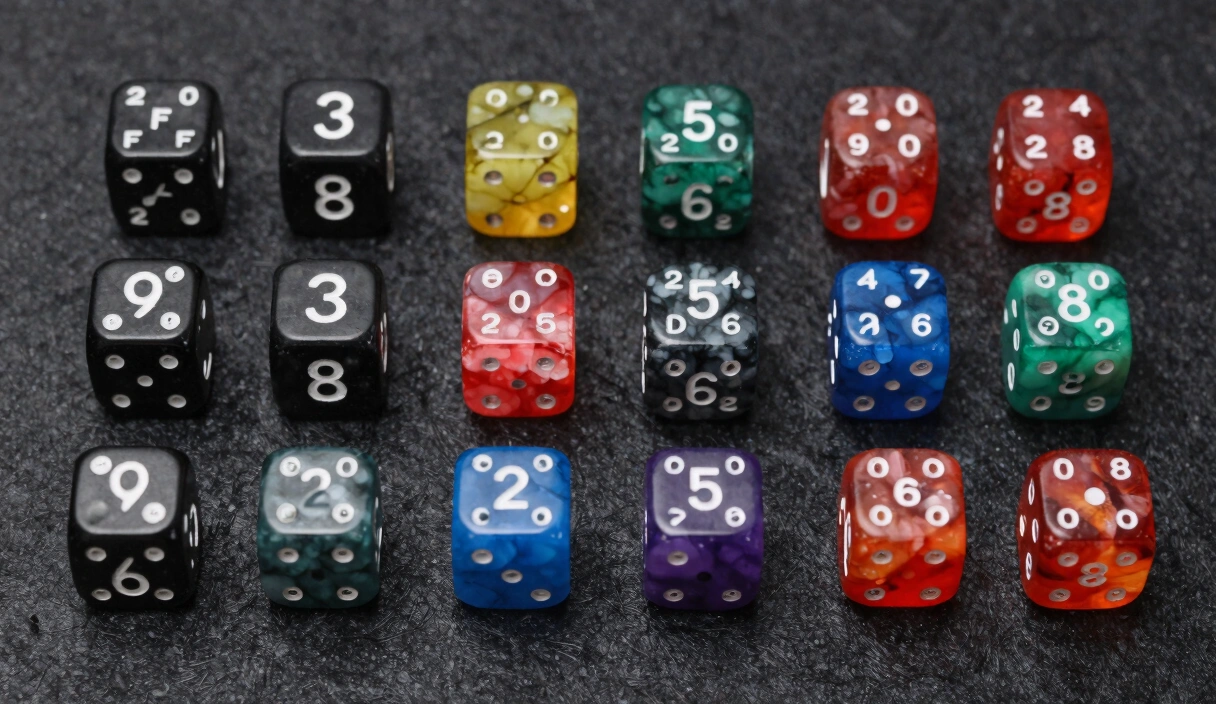
Dice Making Techniques: 6 Methods from Basic Pours to Liquid Core
6 resin dice techniques ranked by difficulty with exact steps, materials, and failure points. Data from 200+ pours across petri, galaxy, inclusion, and liquid core methods.