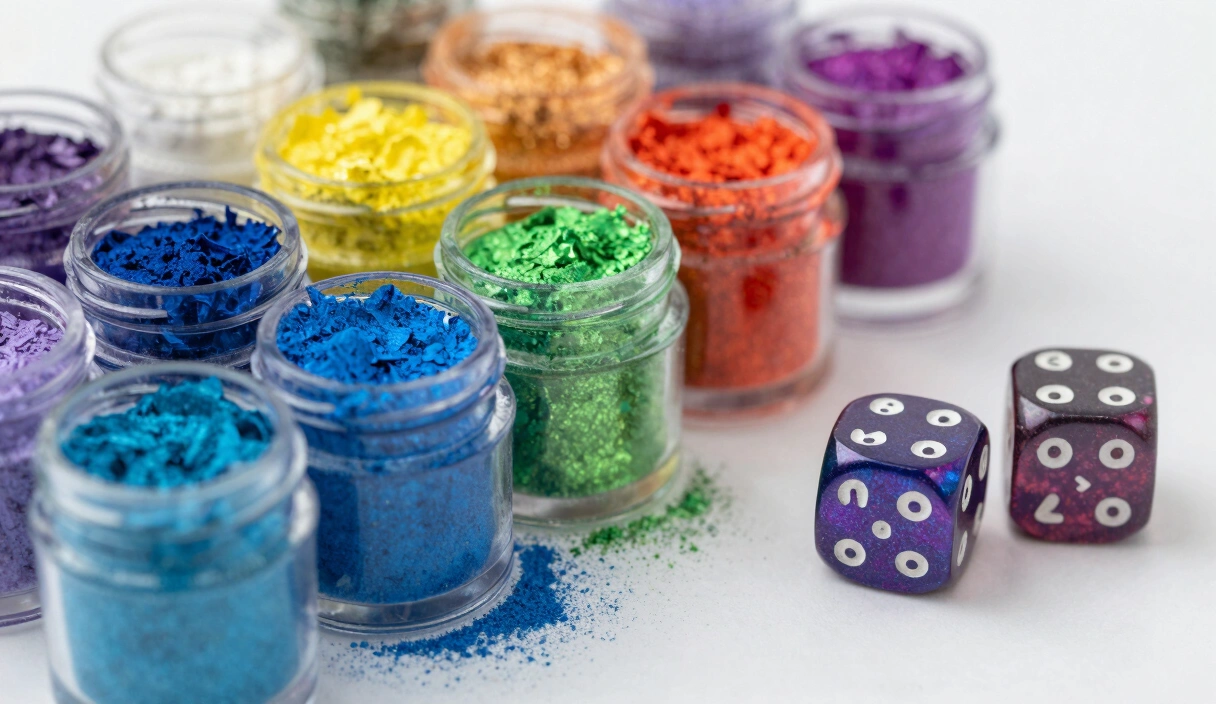
Best Mica Powder for Resin Dice: 4 Brands Tested Side by Side
Tested four mica powder brands in resin dice pours. Honest comparison of particle size, color range, and value so you pick the right one first.
Contents
Which mica powder should you actually buy for dice? You’ll find hundreds of listings — jars, bags, sample packs, stuff labeled “cosmetic grade” next to stuff labeled “craft grade” — and the product photos all look identical. They’re not. The wrong mica clumps in your resin, settles to the bottom of the mold, or turns your translucent pour into a chalky mess. The right mica makes dice that catch light like they’re holding a tiny galaxy inside.
I’ve poured dice with four of the most commonly recommended mica brands. Here’s what actually matters and what I’d spend my money on.
What Mica Powder Actually Is
Mica is a naturally occurring mineral — a silicate, specifically — that forms in thin, flat sheets. Ground into fine particles, those sheets become tiny reflective platelets. When suspended in resin, each platelet catches and bends light, creating that pearlescent shimmer you see in everything from car paint to eyeshadow.
The reason mica works so well in resin is physics. The platelets are transparent enough to let light pass through while reflecting some of it back at shifted angles. That’s what produces the depth effect — you’re not just seeing color on a surface, you’re seeing light bouncing around inside a solid object. For dice, where people hold the finished piece up to light and rotate it in their fingers, that interior shimmer is the entire appeal.
Metallic micas achieve a sharper, more mirror-like reflection by coating the mineral platelets with thin layers of iron oxide or titanium dioxide. Pearlescent micas use thinner coatings for a softer, color-shifting glow. Both work in resin. The choice depends on the effect you’re after.
Maker’s Note: I assumed for a long time that mica was synthetic. It’s not — it’s mined. The “cosmetic grade” label means the particles have been ground finer and screened more carefully for contaminants, not that they were made in a lab.
What to Look for When Buying Mica
Three things separate good mica from frustrating mica: particle size, grade, and color behavior.
Particle Size
This is the single biggest variable. Fine mica (10-60 microns) disperses evenly in resin and produces a smooth, uniform shimmer. It stays suspended well during curing, which matters because dice cure in a mold for 24 hours or more. If the mica settles before the resin gels, all your color ends up on one face.
Coarse mica (60-150+ microns) creates visible sparkle — individual glitter-like flecks rather than a smooth glow. It looks spectacular in galaxy dice and layered pours, but it settles faster and can interfere with number legibility if particles land in the engraved faces of your mold.
For most dice work, start with fine. Add coarse later for specific effects once you understand how mica behaves during your cure cycle.
Cosmetic Grade vs Craft Grade
Cosmetic-grade mica is milled to tighter particle-size tolerances and tested for heavy metals and skin-safe purity. Craft-grade mica may contain larger irregular particles, inconsistent grind sizes, or fillers.
For resin dice, cosmetic grade isn’t strictly necessary — you’re not putting it on your skin. But the tighter grind consistency means more predictable dispersion in resin. Craft-grade mica sometimes contains oversized particles that show up as gritty specks in an otherwise smooth pour. The price difference is usually a dollar or two per jar. Worth it.
Color Shift vs Single Tone
Single-tone micas reflect one color regardless of viewing angle. Color-shift (also called chameleon or duochrome) micas change hue depending on how light hits the platelet — green to purple, gold to red, blue to copper. In a rotating D20, color-shift mica is mesmerizing.
Color-shift micas cost more and come in fewer options. They’re best used as the star of a pour, not mixed with other pigments that compete for attention.
Best Mica Brands Reviewed
I tested each brand by mixing into the same resin at the same ratio, pouring into identical molds, and curing under the same conditions. The goal: see how each mica actually performs in dice, not just in a swatch.
Eye Candy Pigments
Eye Candy is the brand that pops up most in dice-making communities, and for good reason. Their particle size consistency is the best of the four I tested. Fine micas disperse with minimal stirring, stay suspended through a full 24-hour cure, and produce rich, saturated color at low concentrations.
Their color range is enormous — over 50 individual shades — and each jar contains 50 grams, which lasts a surprisingly long time when you’re using toothpick amounts per pour.
Price: $7-9 per 50g jar, or $25-35 for variety packs of 6-10 colors.
Pros:
- Finest, most consistent grind of the four brands
- Excellent suspension in resin — minimal settling
- Wide color range including strong color-shift options
- 50g jars offer genuine value
Cons:
- Individual jar price is higher than bulk sets
- Some metallic shades can overwhelm a pour quickly — easy to add too much
- Not available in every local craft store
Solar Color Dust
Solar Color Dust specializes in color-shift and effect pigments. If you’re making petri dice or anything designed to look otherworldly, this is where to look first. Their chameleon series shifts dramatically between two or three colors depending on angle, and the effect in a cured die is genuinely striking.
The trade-off is a smaller product line for standard single-tone colors, and a higher per-gram price than the competition.
Price: $8-12 per 10-25g jar. The specialty color-shift pigments run toward the higher end.
Pros:
- Best color-shift pigments available for resin
- Dramatic effects that look exceptional in dice
- Fine grind, good suspension
- Strong community following among dice makers
Cons:
- Smaller jars mean higher per-gram cost
- Limited standard color selection
- Specialty pigments can be hard to restock when they sell out
Jacquard Pearl Ex
Pearl Ex has been around for decades. It’s the brand you’ll find in every art supply store, which makes it the default first purchase for a lot of makers. The quality is solid — consistent grind, reliable color — but the formulation is designed for mixed media, paper, fabric, and polymer clay more than casting resin.
In resin, Pearl Ex works fine for opaque or heavily pigmented pours. For translucent shimmer effects, the particles are slightly coarser than Eye Candy or Solar Color Dust, which means more visible individual flecks and slightly faster settling. Not a dealbreaker, but noticeable.
Price: $4-6 per 21g jar, or $20-30 for multi-packs.
Pros:
- Available at nearly every craft store — no waiting for shipping
- Decades of production means consistent quality
- Good for opaque and metallic dice
- Lowest per-jar price for a name brand
Cons:
- Slightly coarser grind than resin-specific brands
- Settles faster in slow-curing resin
- Color range skews toward traditional metallics and earth tones
- Smaller jar size (21g vs 50g)
Let’s Resin Mica Sets
Let’s Resin sells large variety packs — 36 or 48 colors in small individual jars — at an aggressively low price. For beginners building a color library without committing $8 per shade, these sets are appealing.
The quality is a step below the other three. Grind consistency varies between colors within the same set. Some shades disperse beautifully; others clump or go grainy. The pigment concentration is generally lower, so you need more powder per pour to achieve the same saturation, which increases the risk of opacity.
That said, I still keep a set around. When I want to test a color combination before committing Eye Candy pigment to a full pour, I reach for the Let’s Resin jar first.
Price: $12-18 for a 36-color set. That’s roughly $0.35-0.50 per jar.
Pros:
- Cheapest way to get a wide color range
- Good for experimenting and color testing
- Jars are small but functional
- Adequate for opaque dice
Cons:
- Inconsistent grind quality across colors
- Lower pigment concentration requires more powder
- Some colors settle noticeably in 24-hour cures
- Not ideal for translucent or clear-base pours
How Much Mica to Use
Here’s where most beginners go wrong, and I say this having ruined pours myself: you need far less mica than you think.
Start with a toothpick. Dip the tip into the powder, tap off the excess, and stir that into your mixed resin. For a single die’s worth of resin (roughly 15-20ml), that tiny amount often produces a visible shimmer. For a full 7-die set, a small scoop — maybe 1/8 teaspoon — is a reasonable starting point.
The technical guideline is 1-3% mica by weight of your total resin volume. At 1%, you get translucent shimmer where light passes through the die and the mica glows from within. At 3%, the die becomes more opaque with a strong metallic or pearlescent surface look. Past 5%, you’re essentially making a solid-color die with no depth, and the excess mica can weaken the resin’s structural integrity.
Too much mica is harder to fix than too little. You can always add more to your next pour. You can’t take it out.
Budget Reality: A single 50g jar of Eye Candy mica, used at sensible ratios, will last you dozens of full dice sets. Maybe a hundred. Mica is one of the cheapest per-use supplies in the whole dice-making supply list.
Mica vs Other Colorants
Mica isn’t the only way to color resin dice. Each colorant type produces a fundamentally different look, and experienced makers keep all of them on the shelf.
Mica powder creates shimmer and metallic effects. It’s particulate — tiny solid flecks suspended in the resin. Best for: pearlescent dice, metallic dice, anything where you want light interaction.
Alcohol ink is a transparent liquid dye that tints the resin without adding any particulate. It produces stained-glass clarity — color with full transparency. Best for: petri dice (where ink reacts with resin to create organic swirls), transparent tinted dice, layered color effects. Downside: alcohol inks can inhibit resin cure if overused, and the color fades with UV exposure faster than mica.
Pigment paste (like those from Eye Candy or Caster’s Choice) is a concentrated opaque colorant. A single drop goes a long way. Best for: solid opaque dice, strong consistent color without shimmer. Pigment pastes don’t settle or shift — the color is locked in place once mixed.
Liquid dye (transparent resin dye) works like alcohol ink but is formulated specifically for epoxy. It tints without the cure-inhibition risk. Best for: transparent colored dice when you want reliability over the artistic chaos of alcohol ink.
Most of my dice use a combination. A base tint of liquid dye for color, a touch of mica for shimmer, and sometimes an alcohol ink layer for a petri effect on top. The colorants aren’t competing — they’re doing different jobs.
Color Mixing Tips
Mica colors blend predictably because the pigment is physical, not chemical. You’re mixing tiny colored flakes, not reactive dyes. That means color theory works exactly as expected: blue and yellow micas make green, red and white make pink, and complementary colors make mud.
Combinations That Work Well for Dice
Gold + black: The gold shimmer against a dark base creates an antique, treasure-hoard look. Use black pigment paste for the base and gold mica at around 1-2%.
Deep blue + silver: Classic arcane aesthetic. The silver mica catches light through the blue tint like starlight. Works especially well in galaxy dice techniques.
Green + copper color-shift: The warm copper shifts against cool green for a natural, druidic effect. One of my favorite combinations for D20s.
White pearl + any transparent dye: White pearlescent mica in a tinted resin base produces an opalescent glow. Keeps the die translucent while adding that inner-light quality.
Layering for Depth
Instead of mixing two mica colors into one batch, pour in layers. Tint your first partial pour with one color, let it begin to thicken (10-15 minutes depending on your resin’s pot life), then add the second color pour on top. The boundary between layers creates a gradient visible through the finished die.
This works best with fine-grind micas that don’t settle through the partially gelled first layer. Coarse sparkle micas are too heavy — they punch through and sink.
Maker’s Note: I keep a scrap mold — a simple cube shape — specifically for testing color combos before committing to a full dice pour. Five minutes of testing saves an hour of regret. The cube becomes a little reference library of what actually works.
Top Mica Powders and Pigments
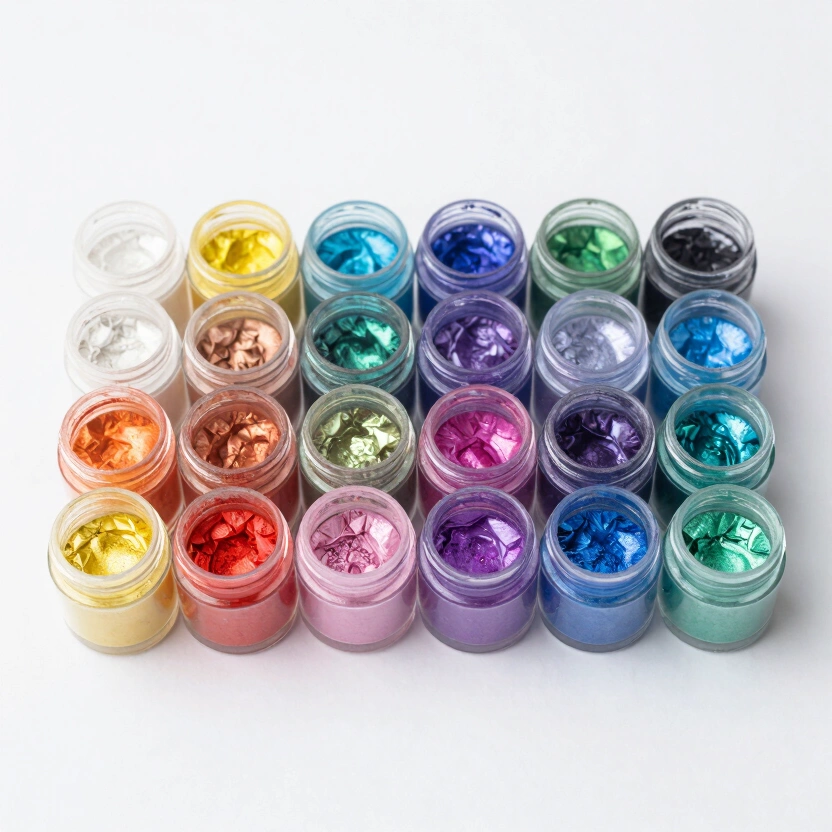
Eye Candy Mica Powder (24-Pack Sampler)
24 vibrant pearlescent pigments. A little goes a long way. Perfect for swirls, layers, and galaxy effects.
Check Price on Amazon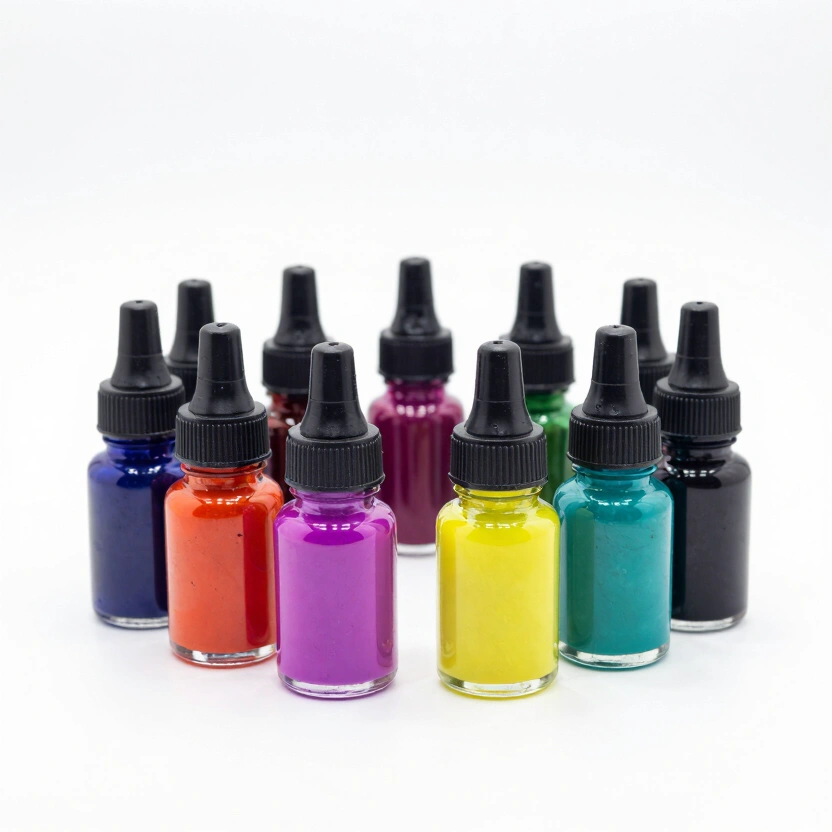
LET'S RESIN Chameleon Color-Shift Pigments
Intense color-shifting chrome powders for resin. Creates stunning multi-tone dice that change in light.
Check Price on Amazon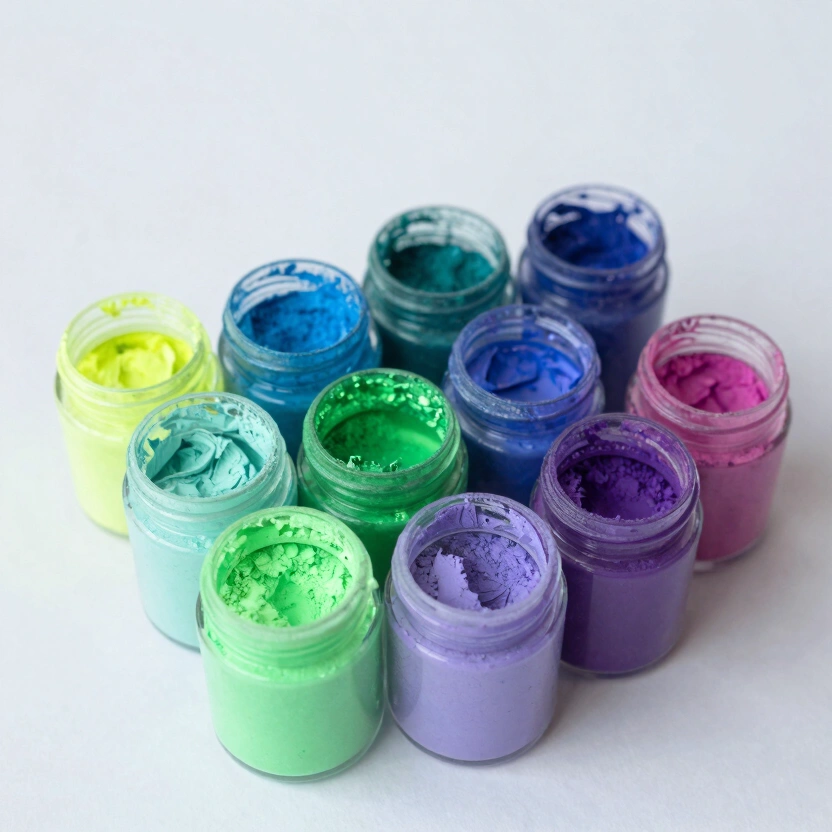
Glow Powder Set (12 Colors, Strontium Aluminate)
Long-lasting phosphorescent pigments for glow-in-the-dark dice. Charges under any light source.
Check Price on Amazon* Affiliate links. Prices last updated March 6, 2026.
FAQ
Can I use craft store glitter instead of mica in resin dice?
You can, but the results are different. Craft glitter is made of cut plastic or metallic film — it produces flat, discrete sparkle points rather than the smooth pearlescent shimmer of mica. Glitter also tends to sink faster in resin and can create rough spots on finished dice faces. For sparkle effects, coarse mica gives a similar look with better integration into the cured resin.
Does mica powder affect how resin cures?
At normal ratios (1-3% by weight), mica has no measurable effect on cure time or hardness. Above 5-6%, the excess particulate can create weak points in the resin matrix, making dice slightly more brittle and prone to chipping during sanding and finishing. Keep your ratios reasonable and you won’t have issues.
How do I stop mica from settling to one side of the die?
Mica settles because of gravity acting on the particles during the long cure window. Three things help: use fine-grind mica (smaller particles settle slower), choose a resin with a shorter gel time so the resin thickens before the mica can migrate far, and keep your curing environment at the warmer end of the recommended range to speed the gel phase. Some makers also rotate their molds 180 degrees partway through curing, though this risks introducing air if the resin hasn’t fully gelled.
Is mica powder safe to handle?
Mica powder itself is non-toxic, especially cosmetic-grade mica. The real concern is inhalation — fine mica particles are a respiratory irritant if you breathe them in while scooping or mixing. Work in a ventilated area, avoid blowing on open jars, and if you’re mixing frequently, a dust mask or P100 respirator (which you should already have for resin work) covers you.
Pick one brand, pick three colors, and pour a set. Eye Candy Pigments is where I’d point anyone buying their first mica specifically for dice — the grind consistency and 50-gram jars make it the best value for resin work. Grab a gold, a blue, and a color-shift that catches your eye. Mix each into a test cube at 1% and 3% so you learn what those ratios actually look like in cured resin. That reference set will save you more wasted pours than any product guide can.
Related Articles
Best Resin for Dice Making: 5 Brands Tested and Ranked
I poured dice with five different resins so you don't waste money guessing. Honest pros, cons, and a clear winner for every budget.
Dice Making Kits: Why Most Are a Waste of Money (and the One Exception)
Most dice making kits sell you $15 of supplies in a pretty box for $50. Here's what they leave out, what to buy instead, and the one time a kit actually makes sense.
Best Dice Bags: From Crown Royal Pouches to Custom Leather
Comparing drawstring pouches, segmented bags, roll-ups, and hard cases for dice storage. Real picks with prices, plus a 30-minute DIY dice bag tutorial.